
On August 1, 1838, Jamaica witnessed one of the most significant moments in its history—the complete abolition of slavery and the end of the Apprenticeship System. After centuries of forced labor and oppression, 311,000 formerly enslaved people finally gained full legal freedom. Across the island, churches overflowed, bells rang, and hymns of liberation echoed through towns and villages as freed people celebrated their long-awaited emancipation.
The End of Slavery
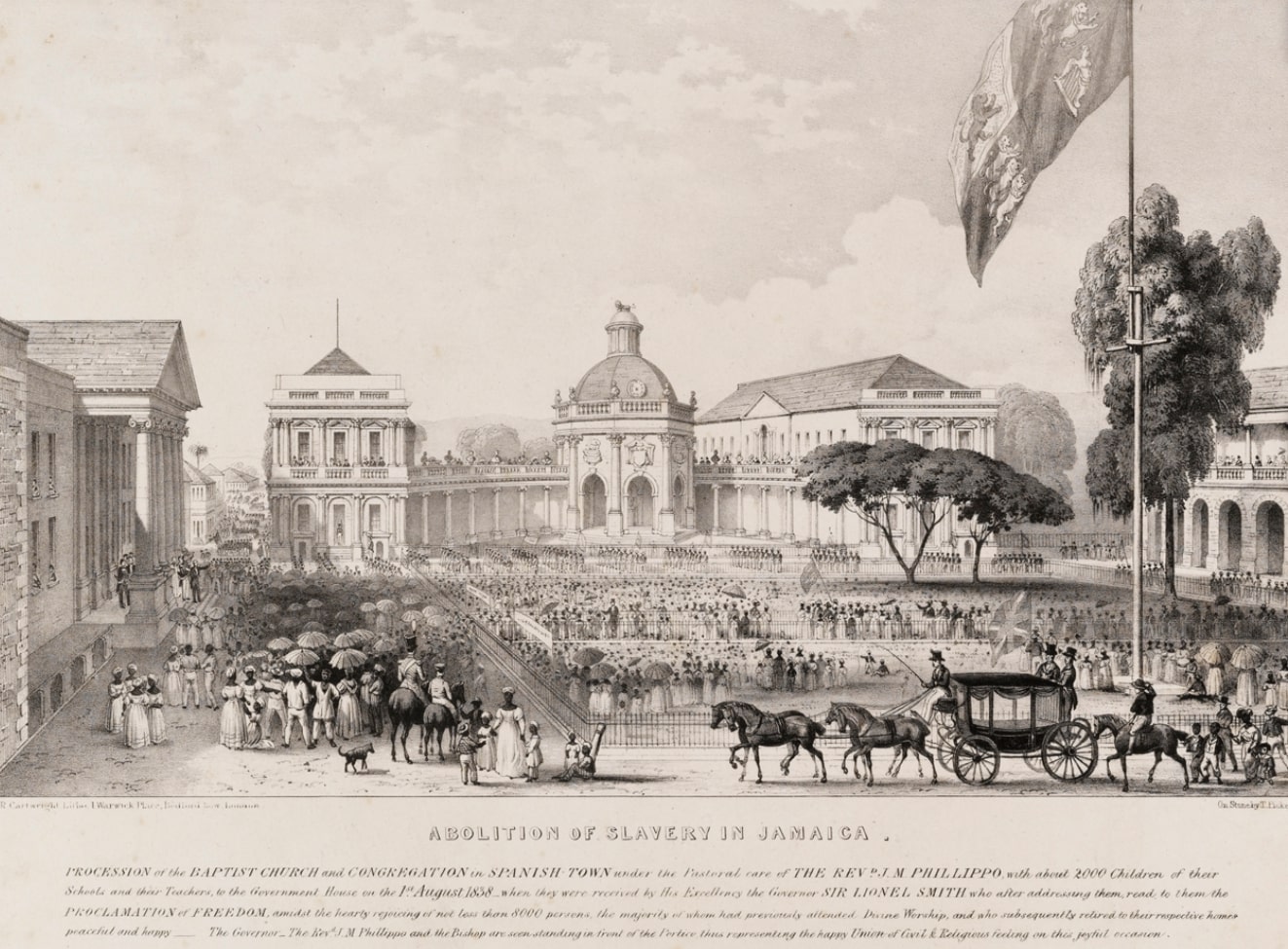
ABOLITION OF SLAVERY IN JAMAICA
Procession of the Baptist Church and congregation in Spanish Town under the pastoral care of The Rev. J. M. Phillippo, with about 2,000 children of their schools and their teachers, to the Government House on the 1st August, 1838—when they were received by His Excellency the Governor, Sir Lionel Smith, who, after addressing them, read to them the Proclamation of Freedom amidst the hearty rejoicing of not less than 8,000 persons, the majority of whom had previously attended Divine Worship, and who subsequently retired to their respective homes peaceful and happy.
The Governor, The Rev. J. M. Phillippo, and the Bishop are seen standing in front of the portico, thus representing the happy union of civil and religious feeling on this joyful occasion.
📌 Source: National Library of Jamaica (NLJ) Archive
One of the largest and most documented celebrations took place in Spanish Town, the capital of colonial Jamaica. Under the leadership of Reverend James Mursell Phillippo, the Baptist Church congregation organized a grand procession to Government House, where they would be received by Governor Sir Lionel Smith.
The procession included around 2,000 children from Baptist mission schools, along with their teachers and thousands of freed people, all marching in celebration. By the time they reached Government House, the crowd had swelled to nearly 8,000 people, gathered with great anticipation to witness the formal declaration of freedom.
Governor Smith addressed the crowd, acknowledging the significance of the moment before reading the Proclamation of Freedom. Cheers erupted as people wept with joy, prayed, and sang hymns—a powerful expression of the faith and resilience that had carried them through generations of enslavement.
As a symbol of unity, Governor Smith, Reverend Phillippo, and the Bishop of Jamaica stood together on the front portico of Government House, representing the collaboration between civil and religious efforts that helped bring about emancipation.
After the reading of the Proclamation of Freedom, the massive gathering peacefully dispersed, with families returning to their homes to reflect on their newfound liberty.
The joy of emancipation was not confined to Spanish Town. Throughout Jamaica’s parishes, similar celebrations took place, demonstrating the depth of emotion and the overwhelming sense of liberation that the day carried.
While August 1, 1838, marked the legal end of slavery, the struggle for economic and social freedom was far from over. However, the day became an enduring symbol of resilience, hope, and self-determination.
For many years, the legacy of August 1 was commemorated through church services, processions, and local celebrations. In 1893, Emancipation Day was first recognized as a public holiday in Jamaica. However, in 1962, following Jamaica's independence, the holiday was discontinued and replaced by Independence Day, observed on August 6.
A movement to reinstate Emancipation Day as a national holiday gained momentum in the 1990s, led by figures such as Professor Rex Nettleford. In 1997, under the administration of Prime Minister P.J. Patterson, Emancipation Day was reinstated as a national public holiday, observed annually on August 1.
Today, Emancipation Day is a time of reflection, cultural pride, and remembrance, honoring the sacrifices and perseverance of those who fought for freedom.
Event: The most well-documented celebration took place in Spanish Town, then the capital of Jamaica.
Activities:
Activities:
Activities:
Activities:
Activities:
Activities: